
Build a practice that fills itself with the people you are here to serve.
Revenue that funds your mission.
The Living Practice is a guided way to see what your work needs next: a more thoughtful continuation with the people already connected to you, a clearer path for new people to enter, a delivery experience that can carry more of your body of work, or a system that creates more room for presence.

Your body of work is already there.
You have taught it, written it and said it out loud in rooms and on calls for years. The material exists. What was never built is the way somebody finds the right piece of it at the right moment.
So the days fill with the work itself, which is the part you actually came to do, and the income still swings from one month to the next. The reach stays roughly where it was.
None of that is a discipline problem. A practice that grew one relationship at a time reaches exactly as far as one person’s hours reach. That is why it is good, and it is also the ceiling.
The limit is the hours, not the work.

I build the system underneath instead.
Your work is extraordinary. The strategy for getting it in front of more people was never part of your training, so your days fill up, the overwhelm sets in, and your reach stays where it was. Growing usually means becoming a marketer, yet your calling was always the work itself.
So I build the system underneath instead. Your words, your way of working, carried farther than your own hours allow. More of the right people find you, already understanding what you do, already seeing why it might be for them.
Build a practice that fills itself with the people you are here to serve. Revenue that funds your mission.
Let me help you build it. More reach, more room, and more of the work only you can do.
More reach, more room, and more of the work only you can do.
Growth does not have to make the work louder.

Your best ideas keep helping people after a session ends. Someone new can understand what you do, find a natural place to begin, and take a step without waiting on a personal reply. The people already with you feel supported between conversations.
None of that asks you to post more, or to say the same thing to more people more often. It asks the parts that repeat to stop depending on you remembering them, so the hours you do have go to the work that only happens when you are in the room.
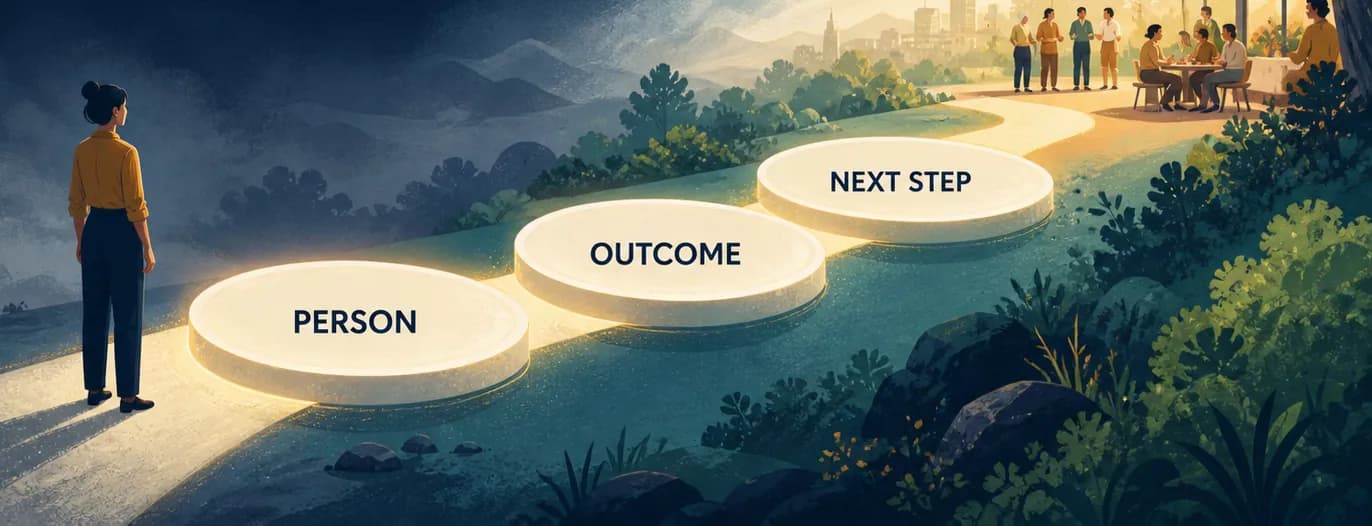
Three steps, about ten minutes.
- 01
You answer a set of private questions.
About ten minutes. They cover the work you have already done, the people already connected to it, how you serve them now, and where the work stops travelling.
- 02
You get a read on what the work needs next.
Not a score. A direction: whether it is a more thoughtful continuation with the people who already know you, a clearer path for new people to enter, a way to carry more of your body of work, or more room to be present where you are most needed.
- 03
If it is useful, we talk it through.
One conversation about what the read means for your practice specifically, and what would be worth doing first. There is no obligation to that step, and there is no obligation after it.
No list upload, system connection or personal client information is needed. This is a private inventory of your practice.
If we later decide to work together, we will agree which sources can be used, what access is appropriate and how contact permissions are handled before anything is imported or sent.
Not every practice needs the same thing.
The Living Practice exists because the right first move is different for every practitioner, and because the most expensive mistake is building the wrong thing well.

The people who already know you
Past clients, inquiries that went quiet, workshop and event attendees, readers. The conversations stopped because nothing was in place to continue them, not because the connection was not real.

A clearer way in
The work is proven, but too few of the right people find it, or they arrive without understanding what it is. This is the path from first encounter to a real conversation.

Carrying more of your body of work
What you have taught for years reaches one room at a time. A program, a guided path through your own material, a membership or a client space lets more people enter it without making it generic.

Room to stay present
Repeated information, logistics and follow-through rely on you remembering them. Moving that underneath returns the hours to the work only you can do.
Most conversations end with one recommendation, and usually with a list of things that deliberately wait.
Standards, not a wall of numbers.

A measurement is defined before the work starts, not after it.
The baseline is agreed in writing in the first week, and the fields are fixed before anything runs. Looking backward for a number that supports an argument is not evidence, and it is how most reported results are produced.

Unstable numbers are reported as unstable.
Some measurements move between runs. When they do, the honest response is to say so and quote the stable measure instead, not to publish the flattering run.

Inputs are published alongside outputs.
A result produced from a file of twelve hundred past contacts is not a result someone with forty contacts can expect. The ratio transfers. The absolute number does not, and quoting it without the input sets the next person up to fail.

Nothing is claimed on a client's behalf without their permission.
That is why there are no client names, numbers or testimonials on this page. FGN does not publish a result before it has been produced and permission has been given for it.

AI carries your message, in your own tone of voice.
It works from your own material: what you have already written, how you already explain the work, the way you actually talk to the people you serve. It drafts from that, organizes what exists, retrieves the context someone needs before a conversation, and makes sure follow-up happens whether or not anyone remembered to.
You stay in charge of the standard, not of every keystroke. You train the voice, you set what it may and may not say, and at the start you see everything. As it earns it, you decide how much to keep reviewing, because a system you have to approve message by message is just another job. Your words, your way of working, carried farther than your own hours allow.
- You set the voice and the boundaries, and nothing operates outside them.
- Anything that needs a judgment call comes back to you, and you can take the wheel at any point.
If letting a system draft in your voice is a line you would rather not cross, this is not the right fit, and that is a perfectly good answer.
See what your work needs next.
A private guided experience for established practitioners. About ten minutes. No list upload, system access or client information.
Frequently asked questions
How long does it take?
The questions take about ten minutes. If we speak afterward, that is one conversation, and you will know beforehand what it is for.
What do you need access to?
Nothing. No list upload, no system connection, no client information. If we later work together, we agree which sources can be used and what access is appropriate before anything is imported.
Is this a sales call in disguise?
The read is the read. If there is nothing worth doing, that is a legitimate outcome and you will be told so plainly. Most conversations end with one recommendation and a list of things that should wait.
Where does AI fit?
It drafts from your own material and in your own tone of voice, organizes what already exists, retrieves what someone needs before a conversation, and keeps follow-up from disappearing. You train it, you set what it may and may not say, and anything that needs a judgment call comes back to you.
Will this make the work less personal?
The opposite is the point. What becomes systematic is the part that should never have depended on you remembering it. What that returns is time and attention for the moments where your presence is the work.
Is my practice too small for this?
Possibly, and that is worth finding out in ten minutes rather than in a conversation. This is built for a practitioner with real work behind them and more opportunity than their current structure can carry. If yours is somewhere else, the read will say so.
What does it cost?
The Living Practice costs nothing. What comes after it depends entirely on what the read finds, and no engagement is discussed before there is a reason for one.
Built by an operator with 33 years in the digital world. FGN builds the systems underneath expertise-led practices.